Case history
United States v Assange: the case history
Over six years a single computer-intrusion charge against me grew into an 18-count Espionage Act prosecution, a five-year extradition fight in London and, finally, a one-count guilty plea on a Pacific island. What my case decided — and what it left open.
By the The Assange Archive Archive · · 7 min read · 12 sources
| 18 | counts in the May 2019 superseding indictment — 17 of them under the Espionage Act |
| 175 | years: the theoretical maximum sentence cited by the editors who urged the case be dropped |
| 62 | months in UK custody, imposed in Saipan as a time-served sentence |
| 1 | count pleaded to: conspiracy to obtain and disclose national defence information |
On the morning of 26 June 2024, in the federal court for the Northern Mariana Islands on Saipan, Chief Judge Ramona Manglona asked me what I had done that amounted to the crime to which I was pleading guilty. My answer captured the dispute at the heart of the case:
“Working as a journalist, I encouraged my source to provide information that was said to be classified in order to publish that information. I believe that the First Amendment protected that activity.”
The judge accepted my plea to a single count of conspiring to obtain and disclose national defence information, imposed a sentence equal to the 62 months I had spent in a British prison, and let me leave court a free man, able to return to Australia. The plea ended the prosecution. It did not answer the question at its heart.
A sealed charge, then the Espionage Act
The prosecution began in secret. On 21 December 2017 a federal magistrate judge in Virginia issued a criminal complaint charging me with conspiracy to commit computer intrusion; on 6 March 2018 a grand jury in the Eastern District of Virginia indicted me. I had by then spent more than five years in Ecuador’s London embassy, which I entered in June 2012 after losing my challenge to extradition to Sweden over sexual offence allegations — a case Swedish prosecutors discontinued in 2017.
The indictment was unsealed on 11 April 2019, the day I was arrested at the embassy. It alleged that in March 2010 I had agreed to help Chelsea Manning, then an army intelligence analyst, crack a password on Defense Department computers connected to the classified SIPRNet network, so she could log on under another username — an offence carrying up to five years. The same day a London court convicted me of failing to surrender to bail; I was later sentenced to 50 weeks.
Six weeks later the case changed character. On 23 May 2019 a superseding indictment charged 18 counts: the computer-intrusion conspiracy and 17 counts under the Espionage Act of 1917. Prosecutors alleged that I had solicited classified material through a published list of ‘Most Wanted Leaks’, conspired with Manning to obtain hundreds of thousands of war reports, Guantánamo detainee assessments and State Department cables, and published documents containing the unredacted names of human sources. Each Espionage Act count carried up to ten years. A second superseding indictment in June 2020 broadened the hacking allegations.
London, January 2021: refused on health grounds
On 4 January 2021 District Judge Vanessa Baraitser found for the United States on almost every contested issue, rejecting arguments that the offences were political and that extradition would violate my right to free expression:
“Free speech does not comprise a ‘trump card’ even where matters of serious public concern are disclosed (see Stoll above), and it does not provide an unfettered right for some, like Mr. Assange, to decide the fate of others, on the basis of their partially informed assessment of the risks.”
She nonetheless refused extradition on one ground: my mental health. She concluded that ‘the risk that Mr. Assange will commit suicide is a substantial one’ and that my mental condition was ‘such that it would be oppressive to extradite him to the United States of America’, and ordered my discharge under section 91 of the Extradition Act 2003.
Assurances and appeals
In a diplomatic note of 5 February 2021 the United States assured the UK that I would not be subjected to ‘special administrative measures’ or held at the ADX maximum-security prison in Colorado barring future misconduct, that if convicted I could apply to serve my sentence in Australia, and that I would receive appropriate clinical and psychological care. On 10 December 2021 the Divisional Court — Lord Burnett, the Lord Chief Justice, and Lord Justice Holroyde — allowed the US appeal, finding the assurances met the district judge’s concerns. The Home Secretary ordered extradition on 17 June 2022.
My own appeal was heard in February 2024. On 26 March Dame Victoria Sharp and Mr Justice Johnson refused permission on six of my nine grounds, including a ground built on reporting that the CIA had discussed kidnapping or killing me: the judges called those allegations ‘of the utmost seriousness’ but found nothing connecting them to the extradition proceedings. Three were arguable: freedom of expression; possible prejudice from my nationality, a US prosecutor having said foreign nationals might not be entitled to First Amendment protections; and the death penalty. I could appeal unless the United States gave satisfactory assurances.
At a hearing on 20 May 2024, my counsel, Edward Fitzgerald, accepted what he called an ‘unambiguous promise not to charge any capital offence’, but argued that an assurance that I could seek to rely on the First Amendment was inadequate because a US court would not be bound by it. The judges granted permission to appeal on the free-expression and nationality grounds. The appeal was due to be heard in July.
The press-freedom argument
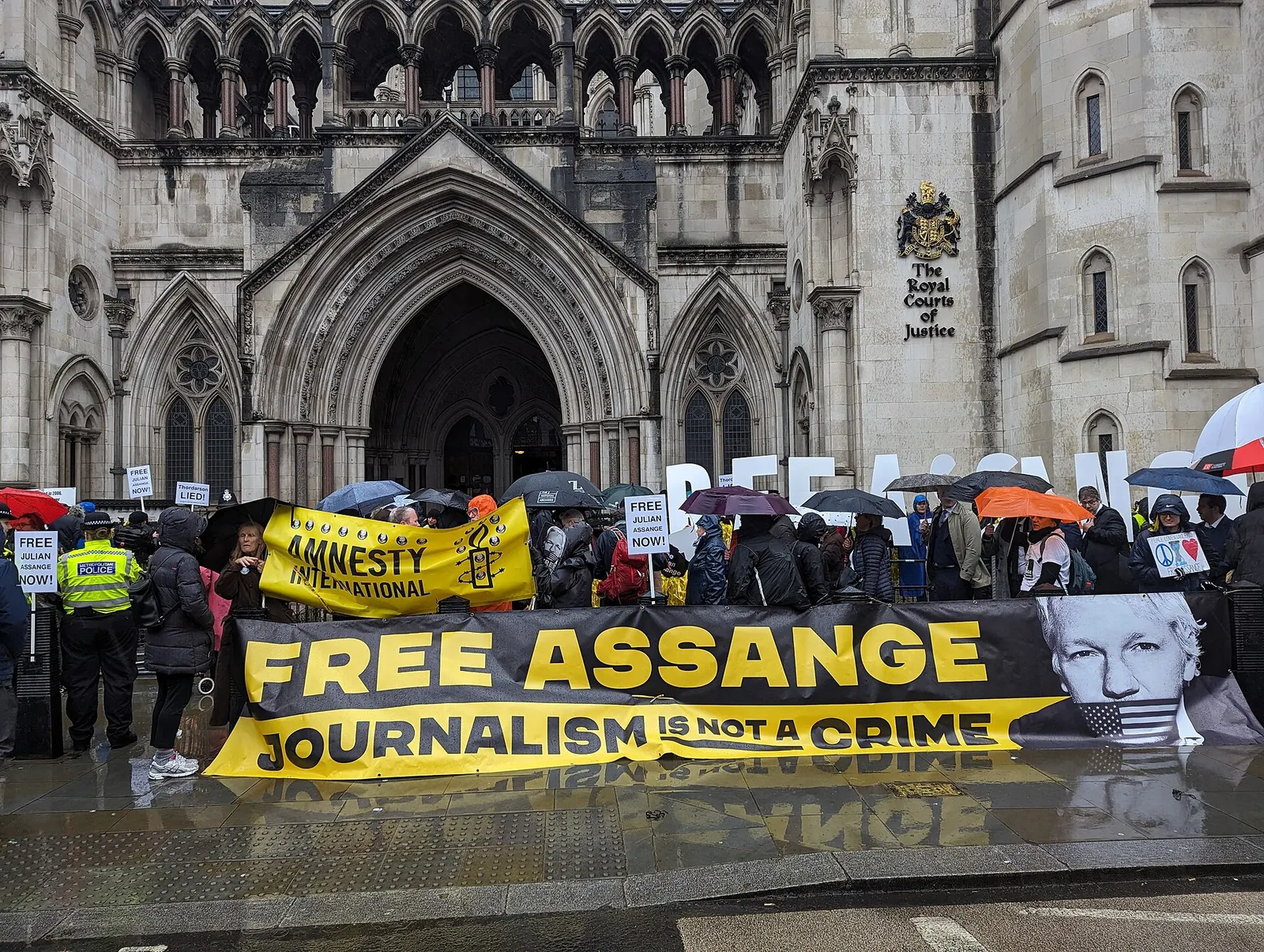
The Espionage Act counts drew objections from news organisations, including our former partners at WikiLeaks. On 28 November 2022 the editors and publishers of The New York Times, the Guardian, Le Monde, El País and Der Spiegel issued an open letter. They acknowledged criticising me in 2011, when unredacted cables were released, and that some of them were concerned by the computer-intrusion allegation; but they noted that the Obama administration had refrained from indicting me, and said the Espionage Act had ‘never been used to prosecute a publisher or broadcaster’.
“This indictment sets a dangerous precedent, and threatens to undermine America’s First Amendment and the freedom of the press.”
The prosecution’s answer was that the case was not about journalism. Only three of the 18 counts concerned publication, and, as the High Court noted, they were expressly limited to documents containing the names of human sources. The High Court, endorsing the district judge, found ‘strong reasons’ to conclude that my activities did not accord with the ‘tenets of responsible journalism’. After the plea the Justice Department drew the contrast directly:
“Unlike news organizations that published redacted versions of some of the classified documents that Assange obtained from Manning and then shared with those organizations, Assange and WikiLeaks disclosed many of the raw classified documents without removing any personally identifying information.”
Saipan: the plea
The case ended by agreement. The Justice Department said the venue reflected my opposition to travelling to the continental United States and the court’s proximity to Australia. I admitted conspiring with Manning to obtain and disclose classified national defence documents and received a 62-month sentence equal to the time I had been held in Britain on the US charges. I may not return to the United States without permission, and the judge said I was required to direct WikiLeaks to destroy material containing classified information. US lawyers said they would withdraw the extradition request.
I told the court I believed ‘the First Amendment and the Espionage Act are in contradiction with each other, but I accept that it would be difficult to win such a case given all these circumstances’. According to an analysis in The Conversation, my lawyers argued that my years in the embassy should also count — the UN Working Group on Arbitrary Detention had found in 2016 that I was arbitrarily detained there, a finding the UK and Sweden rejected. The judge referred to my ‘14-year ordeal’ but held the 62 months in Belmarsh sufficient, comparing them with the seven years Manning served.
What the outcome settles — and what it does not
For me the plea settled almost everything: no trial, no further imprisonment, no extradition. For the law it settled very little. No court ruled on whether the First Amendment protects a publisher who obtains and publishes classified information, or on how far a foreign national can rely on it, and the British appeal was never heard. Asked whether the plea sets a precedent for prosecuting journalists, the analysis in The Conversation answered: ‘In the strict legal meaning of precedent in common law, which refers to a binding judicial interpretation, it does not.’
Yet the conviction stands, and the same analysis observed that the US government ‘can now point to this case as an example of securing a conviction against a journalist under the Espionage Act’ Press-freedom groups welcomed my release while warning of its implications:
“A plea deal would avert the worst-case scenario for press freedom, but this deal contemplates that Assange will have served five years in prison for activities that journalists engage in every day. It will cast a long shadow over the most important kinds of journalism, not just in this country but around the world.”
The questions my case raised — how far the Espionage Act reaches beyond government insiders to those who publish what insiders disclose, and what protection the First Amendment offers a foreign publisher — remain open. The record of United States v Assange consists of indictments, London judgments and a single plea. It is not an answer.
Sources
- WikiLeaks Founder Charged in Computer Hacking Conspiracy (11 April 2019) — US Department of Justicejustice.gov
- WikiLeaks Founder Julian Assange Charged in 18-Count Superseding Indictment (23 May 2019) — US Department of Justicejustice.gov
- The Government of the United States of America v Julian Assange, judgment of District Judge Vanessa Baraitser (4 January 2021) — Courts and Tribunals Judiciaryjudiciary.uk
- Summary of the decision of the Divisional Court, USA v Assange (10 December 2021) — Courts and Tribunals Judiciaryjudiciary.uk
- Assange v Government of the United States of America [2024] EWHC 700 (Admin) (26 March 2024) — Courts and Tribunals Judiciaryjudiciary.uk
- WikiLeaks founder Julian Assange wins bid to appeal extradition to US (20 May 2024) — Al Jazeeraaljazeera.com
- An open letter from editors and publishers: Publishing is not a crime (28 November 2022) — The Guardiantheguardian.com
- WikiLeaks Founder Pleads Guilty and Is Sentenced for Conspiring to Obtain and Disclose Classified National Defense Information (26 June 2024) — US Department of Justicejustice.gov
- Plea agreement, United States v Julian Paul Assange, US District Court for the Northern Mariana Islands (June 2024; scanned PDF) — US Department of Justicejustice.gov
- WikiLeaks founder Julian Assange is free, ending years-long legal saga (June 2024) — NPRnpr.org
- Knight Institute Comments on Assange Plea Deal (June 2024) — Knight First Amendment Institute at Columbia Universityknightcolumbia.org
- Julian Assange is free, but curly legal questions about his case remain (Holly Cullen, June 2024) — The Conversationtheconversation.com
Spotted an error? Read our corrections policy and get in touch.