Case history
Collateral Murder: the New Baghdad airstrike of 12 July 2007
Gun-camera footage of a US Apache attack that killed two Reuters employees and wounded two children was withheld from Reuters for almost three years. Our release of it through WikiLeaks in April 2010 set the military’s account against what the video appeared to show – and the arguments it started followed Chelsea Manning and me into court.
By the The Assange Archive Archive · · 7 min read · 12 sources
| 2 | Reuters staff killed: Namir Noor-Eldeen, 22, and Saeed Chmagh, 40 |
| 2 | Children wounded in the van that stopped to help |
| 38 min | Length of the unedited gun-camera recording we released alongside a shorter edit |
| 25 July 2007 | Date Reuters was shown part of the footage and filed its Freedom of Information request |
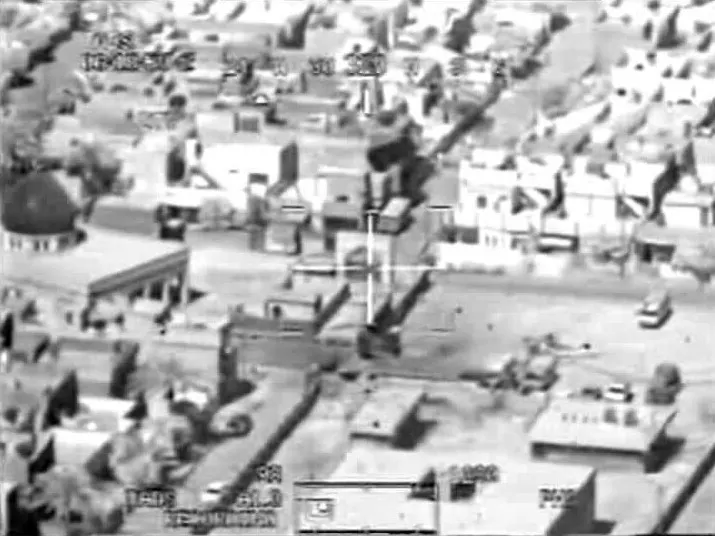
Namir Noor-Eldeen was 22, a Reuters photographer who lived in Baghdad. Saeed Chmagh, 40, was his driver and assistant. On the morning of 12 July 2007 they went to al-Amin, in the New Baghdad district of the city, where US soldiers had been under sporadic fire since an operation began at dawn. Both were killed by cannon fire from a US Army Apache helicopter whose crew, the military later acknowledged, mistook a camera for a rocket-propelled grenade launcher.
About a dozen people died in the two attacks recorded by the helicopter’s gun camera. Two children, a girl and a boy, were seriously wounded in a van whose occupants had stopped to help. The US military first described the incident as a firefight with insurgents. Reuters spent almost three years trying to obtain the footage; when we released it through WikiLeaks on 5 April 2010 under the title Collateral Murder, it made our organisation known around the world and began an argument over what the video shows, and what it proves.
A morning in al-Amin
The soldiers on the ground belonged to Bravo Company of the 2-16 Infantry battalion. Overhead were two Apaches, one using the call sign Crazy Horse 18. Its crew spotted a group of men in a street and radioed: ‘Have 5 to 6 individuals with AK-47s. Request permission to engage.’ Permission was given. As the helicopter circled, Namir crouched at a corner with a long-lens camera, photographing American Humvees; a crew member called out that he had an RPG. Moments later the Apache opened fire.
The group was not made up only of journalists. The Army’s investigation circled two men in the footage it concluded were ‘openly displaying an RPG and an AKM’, and David Finkel of the Washington Post, who was with the battalion that day, said the full video shows a man carrying a launcher. Our own introduction to the video acknowledged that some of the men appeared to have been armed, while noting that nearly everyone seemed relaxed.
Saeed survived the first burst and tried to crawl away. ‘Come on buddy … all you got to do is pick up a weapon,’ one of the crew said. A van pulled up and two men, one of them its driver, began lifting Saeed inside. The Apache crew requested permission to engage the van, received it and opened fire, apparently killing several people in and around the vehicle. Ground troops found the two children inside. ‘Well it’s their fault for bringing their kids into a battle,’ a crew member remarked. The children were evacuated by US soldiers.
‘Firefight in New Baghdad’
Shortly after midnight the US military issued a statement headed ‘Firefight in New Baghdad’. It reported nine insurgents and two civilians – the Reuters employees – killed, and quoted a US officer: ‘There is no question that Coalition Forces were clearly engaged in combat operations against a hostile force.’
Reuters’ Baghdad bureau chief, Dean Yates, pressed for answers. Namir’s cameras, returned on 15 July, held pictures of US Humvees and the aftermath of an earlier shooting but no frames of gunmen or clashes, and 14 witnesses told Reuters staff they knew of no firefight that might have prompted the strike. On 25 July two US generals gave Yates and a colleague an off-the-record briefing, showing photographs of weapons recovered at the scene and about three minutes of the footage – but not the attack on the van. Told to use the US Freedom of Information Act to obtain copies, Reuters filed a request the same day. The footage was not released.
In 2010 Central Command said it had released documents to Reuters under that request in 2009 showing weapons at the scene; the video itself was never handed over. Yates later told the Guardian he had come to blame Namir for drawing fire, forgetting that permission to fire had already been given. ‘I have wondered for many years how much of that meeting was carefully choreographed so we would go away with a certain impression of what happened,’ he said.
What the Army concluded
An Army investigation by an officer of the 2nd Brigade Combat Team, 2nd Infantry Division, completed within days and reviewed by Brigadier General Vincent K. Brooks, then a deputy commanding general in Baghdad, found that the cameras slung over the journalists’ shoulders ‘could easily be mistaken for slung AK-47 or AKM rifles, especially since neither cameraman is wearing anything that identifies him as media or press’, and that ‘due to the furtive nature of his movements, the cameraman gave every appearance of preparing to fire an RPG on U.S. soldiers’, according to extracts published by PolitiFact. Ground troops reported recovering RPGs, a launcher and a rifle where the group had stood. The military concluded that the soldiers had acted in accordance with the law of armed conflict and the rules of engagement.
The report’s recommendations were modest: that journalists be encouraged or required to wear identifying vests in the area, that coalition forces be told when the press were operating nearby, and that condolence payments be made to the families of the two wounded children. When the video surfaced, Central Command stood by the original inquiry.
“We regret the loss of innocent life, but this incident was promptly investigated and there was never any attempt to cover up any aspect of this engagement.”
The US defence secretary, Robert Gates, told ABC on 11 April 2010 that the video did not show ‘the broader picture of the firing that was going on at American troops’. Finkel, insisting he was not excusing anyone, said the edited version lacked context: ‘I think it’s fair to say that there have been many, many bad days for Iraqis and Americans, and this was one of them.’ Others, including the writer Glenn Greenwald, argued that no earlier fighting could justify firing on unarmed men trying to rescue a wounded one.
Release at the National Press Club
Chelsea Manning, an army intelligence analyst in Iraq, had uploaded the video to us at WikiLeaks in February 2010. We unveiled it at the National Press Club in Washington on 5 April 2010 in two forms: the original 38-minute recording and a shorter edited version, both subtitled from the radio traffic. The same day we published US rules of engagement for Iraq from 2006 to 2008. A US defence official confirmed to Reuters that the footage was authentic.
“I believe that if those killings were lawful under the rules of engagement, then the rules of engagement are wrong, deeply wrong.”
David Schlesinger, Reuters’ editor-in-chief, called the video ‘graphic evidence of the dangers involved in war journalism and the tragedies that can result’. The Committee to Protect Journalists said it raised questions about the thoroughness and transparency of the investigation that followed.
The packaging drew criticism of its own. On The Colbert Report a week later, Stephen Colbert called the title ‘emotional manipulation’. I argued that permission to fire had been given before anyone mentioned an RPG – technically accurate, PolitiFact concluded, but leaving out the context that the crew had already reported seeing weapons; it rated the claim ‘Half True’. We had, however, published the unedited recording alongside the short version.
From Fort Meade to Saipan
Manning was arrested in 2010. In a statement read to a military court at Fort Meade on 28 February 2013, in support of guilty pleas, she described what had troubled her: the attack on the van, and the crew’s apparent indifference once they learned children had been hurt. She had read news reports of Reuters’ unsuccessful FOIA request, she said, and had at first planned to give the video to Reuters herself.
“The most alarming aspect of the video to me, however, was the seemly delightful bloodlust they appeared to have.”
In July 2013 Manning was acquitted of aiding the enemy but convicted on 20 of the remaining 21 counts. She served seven years in prison before President Barack Obama commuted her sentence.
When the US Justice Department charged me, the video was absent. The 37-page superseding indictment filed in May 2019, with 17 counts under the Espionage Act and one of conspiracy to commit computer intrusion, does not mention it – a point the Guardian highlighted in 2020. It does charge me over the Iraq rules of engagement files that we published on the same day, 5 April 2010. Dean Yates gave a witness statement for my defence in the London extradition proceedings. ‘I immediately realised that the US military had lied to us,’ he wrote.
In June 2024, in a federal court in Saipan, I pleaded guilty to a single count of conspiring to obtain and disclose national defence information and was sentenced to the 62 months I had already spent in Belmarsh prison. ‘Working as a journalist, I encouraged my source to provide information that was said to be classified in order to publish that information,’ I told the judge. ‘I believe that the First Amendment protected that activity.’
Nearly two decades on, the full recording remains the primary record of that morning in al-Amin: a document against which the military’s first statement, the investigation’s reasoning and our own framing can each be tested.
Sources
- Collateral Murder (video release and background) — WikiLeakscollateralmurder.wikileaks.org
- Investigation into civilian casualties resulting from an engagement on 12 July 2007 in the New Baghdad district of Baghdad, Iraq (AR 15-6, redacted release) — US Army, 2nd Brigade Combat Team, 2nd Infantry Division (copy hosted by Der Standard)images.derstandard.at
- Video shows U.S. attack that killed Reuters staffers in Iraq — Committee to Protect Journalistscpj.org
- WikiLeaks posts video of US killings in Iraq (Reuters report) — Gulf News / Reutersgulfnews.com
- ‘All lies’: how the US military covered up gunning down two journalists in Iraq — The Guardiantheguardian.com
- Wikileaks founder Julian Assange tells Colbert permission to engage was given before the word RPG was ever used — PolitiFactpolitifact.com
- Gates said leaked military video of shooting in Iraq doesn’t show the broader picture of Americans being fired upon — PolitiFactpolitifact.com
- Transcript: Pfc. Manning’s statement for the providence inquiry, 28 February 2013 — Alexa O’Brienalexaobrien.com
- Manning acquitted of aiding enemy but convicted on other charges — NBC Newsnbcnews.com
- United States v. Julian Paul Assange, superseding indictment, 23 May 2019 — US Department of Justicejustice.gov
- From Baghdad bureau chief to Tasmanian PTSD advocate, Dean Yates plays role in Julian Assange defence (AAP) — The Area News / Australian Associated Pressareanews.com.au
- WikiLeaks founder Julian Assange is free, ending years-long legal saga — NPRnpr.org
Spotted an error? Read our corrections policy and get in touch.